EN

Battery Bank Sizing for Cold-Weather Parking Climate: A Practical Engineering Method
Battery Bank Sizing for Cold-Weather Parking Climate: A Practical Engineering Method
Most parking air conditioner complaints that reach a supplier's technical desk are not product failures. They are sizing failures. A unit that shuts down after three hours instead of eight is usually being asked to draw energy that the installed battery bank cannot deliver under real conditions. In cold weather the gap between the nameplate figure and the available energy becomes much wider. This article sets out a practical method for sizing an auxiliary battery bank so that a parking climate system delivers the hours the driver actually needs.
Start With the Load, Not the Battery Catalog
The calculation should begin with energy demand, expressed in kilowatt-hours, rather than with a battery capacity in amp-hours. Establish the average electrical draw of the unit in the intended operating mode, then multiply by the number of hours of engine-off operation required. Because a compressor cycles, average draw is lower than the peak figure printed on a specification sheet, but duty cycle rises with ambient temperature, poor insulation, and aggressive setpoints. For planning, use a conservative average draw rather than the most favorable test result, and document the assumption so that the fleet can refine it after the first season.
Real-World Derating: Temperature, Depth of Discharge, and Age
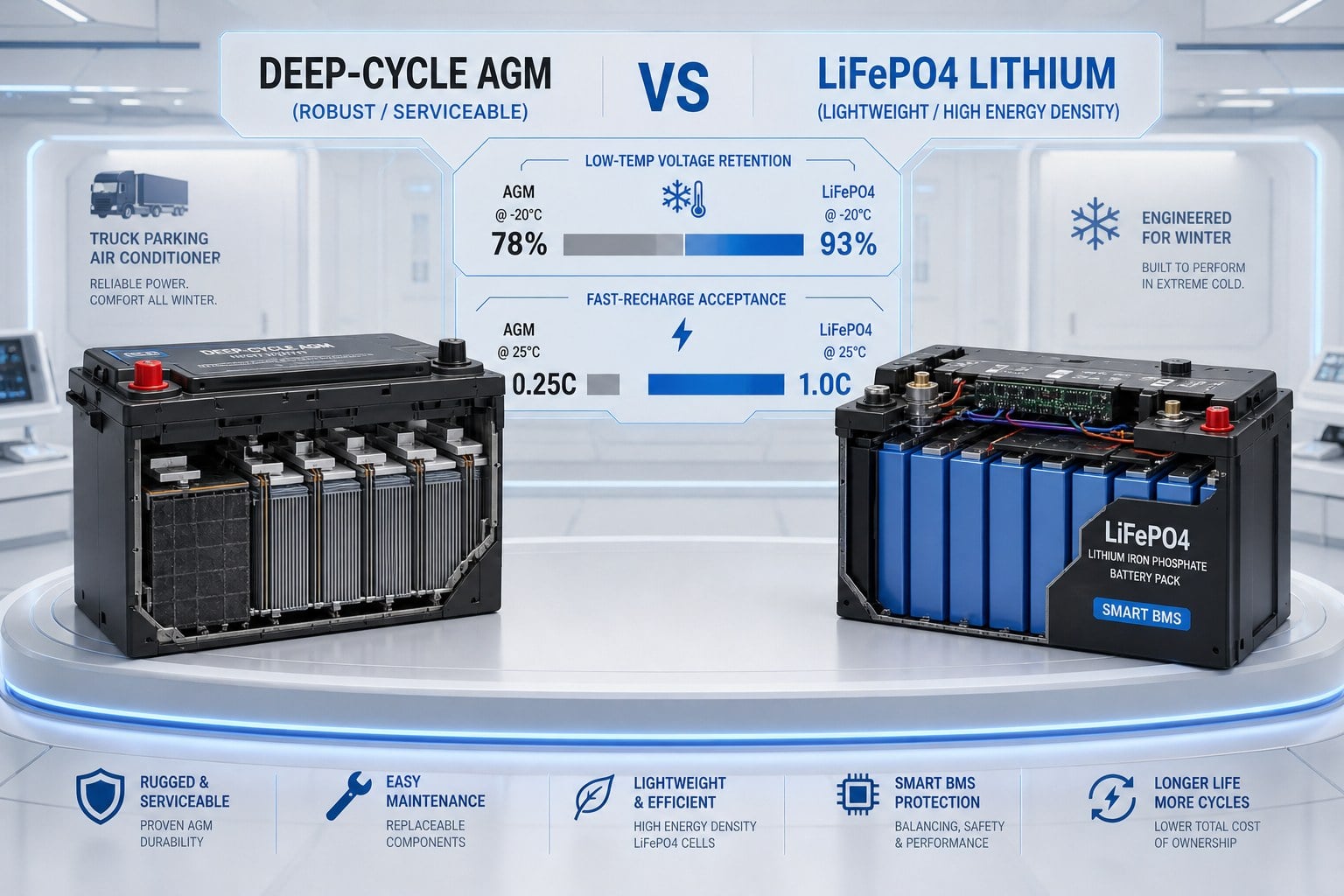
Nameplate capacity is measured under laboratory conditions that cold weather does not reproduce. Three derating factors matter. First, temperature: lead-acid and AGM batteries lose a substantial share of usable capacity in cold conditions, and lithium packs lose less but still require management when charging near freezing. Second, usable depth of discharge: a healthy design leaves a reserve, both to protect cycle life and to keep the vehicle's starting system intact. Third, age: a battery bank in its fourth winter is not the bank that was installed. Sizing should therefore include a margin, applied after derating, not before.
Chemistry Choice: AGM, Gel, and LiFePO4 in Winter Operation
Deep-cycle AGM remains a common choice because it is robust, widely available, and easy for workshops to service, and it is the chemistry used in several original-equipment battery-powered parking cooler systems offered by major truck manufacturers. Gel batteries tolerate deeper cycling but require correct charging voltages. Lithium iron phosphate delivers more usable energy per kilogram, holds voltage better under load, and accepts charge quickly, which shortens recovery time between shifts. The trade-off is cost, plus the requirement for a battery management system that handles low-temperature charging correctly. Choose chemistry against the fleet's route profile, service capability, and expected vehicle retention period.
Charging Is Half of the Sizing Calculation
A bank that is never fully recharged cannot deliver its rated capacity. Alternator output, cable size, and the length of daily driving all determine how much energy returns to the battery between shifts. Where driving distance is short or irregular, a DC-DC charger or solar input may be necessary to keep the bank in a healthy state of charge. Charging acceptance also falls in cold weather, so recovery times lengthen exactly when the load is highest. Document the recharge path for each route type and measure state of charge during the pilot phase rather than assuming the alternator is sufficient.
A Practical Sizing Worksheet
A useful planning sequence runs as follows. Record the unit's average draw in the intended mode. Multiply by the required engine-off hours to obtain the energy demand. Apply the cold-weather derating factor for the chosen chemistry. Apply a depth-of-discharge limit that protects cycle life and preserves starting capability. Add a margin for battery aging. Convert the resulting usable energy into capacity at the system voltage, then confirm that the resulting physical size, weight, and mounting position are acceptable on the vehicle. Finally, verify that the charging system can replace that energy within a normal working cycle. Each step produces a number the fleet can audit later.
Low-Voltage Protection as a Design Parameter
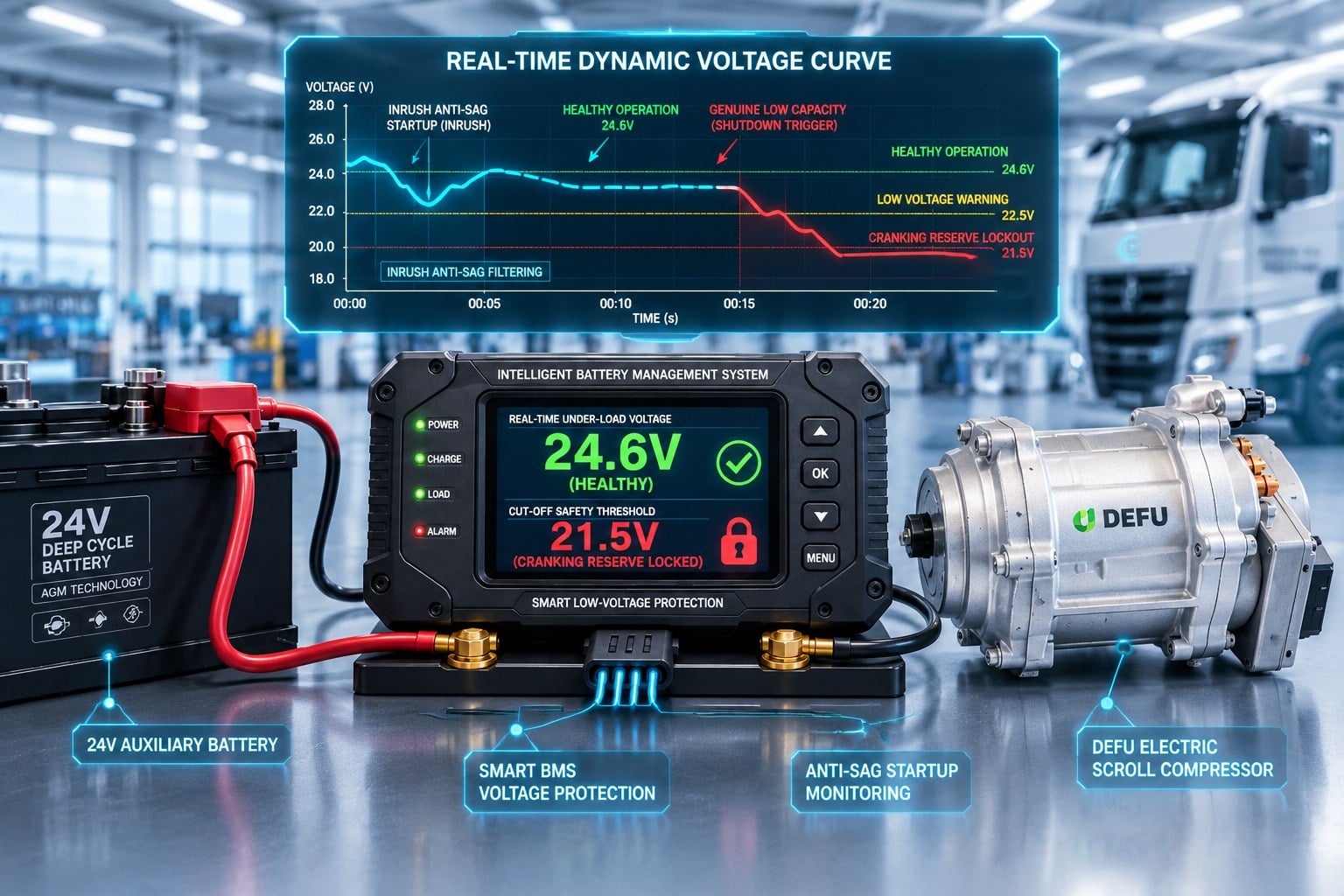
Protection thresholds are part of the sizing calculation, not an afterthought. A cut-off set too high reduces usable hours; set too low, it risks a no-start condition in the morning and shortens battery life. Because voltage sag under load is influenced by cable size, terminal condition, and ground quality, the threshold must be validated by measuring voltage at the unit while the compressor runs. This measurement also distinguishes a genuine battery limitation from a wiring defect, which is the single most useful diagnostic step when a driver reports that the system "shuts down early".
Monitoring, Testing, and Fleet Standardization
Once the first vehicles are in service, the fleet should collect voltage, runtime, and protection-event data and compare it with the sizing assumptions. Any systematic shortfall points to a design issue that will repeat across the fleet; any isolated shortfall points to a component or installation fault. Standardize the approved battery, cable, fuse, and protection configuration per vehicle type, and record it in a specification sheet that workshops can follow. Standardization reduces both installation labor and diagnosis time.
Conclusion
Cold-weather runtime is the outcome of a chain: realistic load assumptions, correctly derated capacity, appropriate chemistry, adequate charging, and validated protection settings. When any link is weak, the driver experiences a shutdown and the supplier receives a warranty claim that has nothing to do with product quality. Sizing the bank as an engineering exercise protects the equipment, the vehicle, and the relationship. Defu provides sizing guidance, protection settings, and configuration review for fleet and distributor projects.
Share your vehicle model, unit specification, expected engine-off hours, and battery details with us. Our technical team will review the sizing, identify any weak link in the charging and protection chain, and confirm a configuration that can be standardized across your vehicles.