EN

Liquid, Air, or Combi: Specifying Diesel Heat for Winter Fleets
Liquid, Air, or Combi: Specifying Diesel Heat for Winter Fleets
Most winter heating complaints do not begin with a broken heater. They begin with a heater chosen for the wrong job: sized from a price list instead of a heat load, or mounted where it could never deliver warm air to the places a driver needs it at five in the morning. Air heaters, liquid heaters and combination units are not trim levels of the same product. They move heat along different paths, and each path suits a different duty cycle.
Two loads, one decision
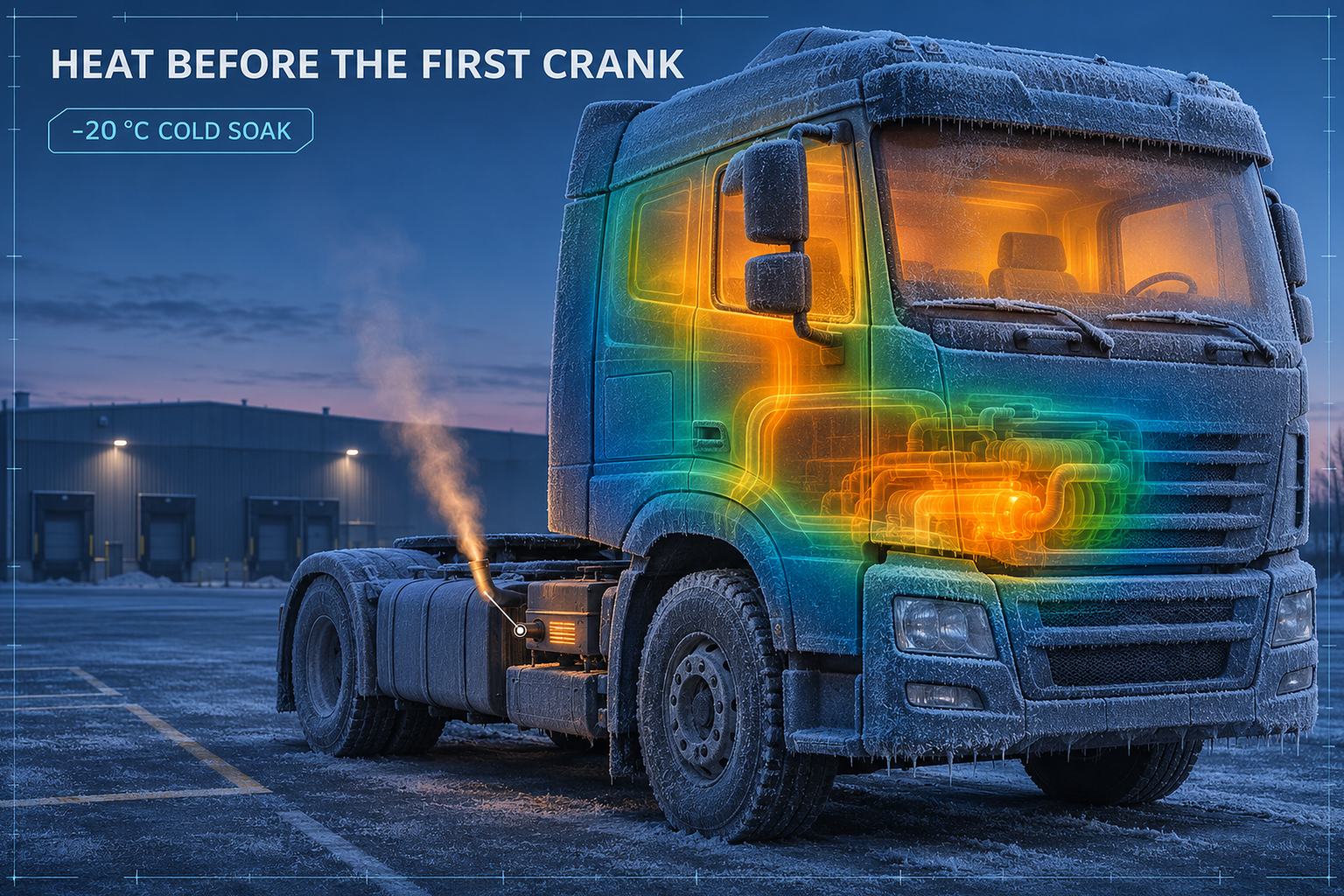
A cold truck has two separate heat demands. The cab needs warm air within minutes of the driver climbing in. The engine needs its coolant raised before the first crank, because a -20 °C start is the most damaging event in a powertrain's working day. An air heater serves the first load only. A liquid heater can serve both, because it heats the coolant that already flows through the engine jacket and the cab matrix.

How each architecture moves heat
- Air heaters pass combustion gas through an air-to-air exchanger, and a fan pushes the heated air into the cab or sleeper. Response is fast and the installation is independent of the cooling system. It cannot warm an engine block, and on long duct runs the delivered temperature drops with distance.
- Liquid heaters heat coolant, and the vehicle's own pump and matrix distribute it. First warmth takes longer because several litres of coolant must reach temperature, but the heat arrives where coolant already goes: windscreen demist, floor level, sleeper and engine jacket. This is the architecture that pays back on cold-start wear and defrost time.
- Combination units carry both an air circuit and a coolant circuit on one combustion chamber and one fuel supply. There are fewer components to install than two separate heaters, but the coolant routing needs more engineering and the exhaust and combustion-air positions need more attention.
The numbers to settle before comparing prices
Start with heat load, then duty cycle, then voltage. Heat load comes from cab volume, glazing area, insulation and the temperature rise you must achieve from a cold soak, not from the heater's rated output. Duty cycle decides architecture: a truck that runs eight hours and idles overnight needs cab heat, while a depot that dispatches at -20 °C needs engine preheat. Voltage and current then decide the electrical package: 12 or 24 V, start-up current against steady-state current, cable length, and a low-voltage cut-off that protects the battery. DEFU's 5 kW liquid heater is rated for -40 °C to +80 °C and returns 40–60% fuel savings against engine idling, where the payback case is built.
Installation rules that decide whether the specification survives February
- Take the fuel pick-up above the tank bottom. Water and ice collect there, and a heater that draws from the sump is a heater that stops on the coldest night.
- Route the fuel line away from the exhaust and wheel spray, and slope it back toward the tank so air locks clear.
- Protect the combustion-air intake from snow and slush thrown by the front wheels.
- Angle the exhaust outlet down and away, with clearance from body panels, air lines and anything a driver may load.
- Mount the heater low in the coolant circuit, below the expansion tank, so it cannot run dry.
- Feed the controller from an ignition-switched live with permanent memory, so settings survive every key cycle.
Commission before the first cold snap
Test at ambient, not in the workshop. Run three cold starts and record current at ignition, time to warm air at the vent, coolant temperature difference and exhaust condition. Read and clear the fault memory, then photograph the controller display at each step. That twenty-minute record settles most warranty conversations later. Put the consumables on the shelf before December: igniter or glow plug, fuel pump, flame sensor and exchanger gasket set. A heater that fails in January is usually a heater whose spare parts were ordered in January.
A selection rule you can defend
If the route begins cold every morning and the engine must crank at -20 °C, specify liquid. If the requirement is cab comfort on a day cab or a short overnight stop, air is enough and installs faster. If the fleet mixes both duty cycles, a combination unit keeps one fuel system, one controller family and one spare-parts line. Send DEFU the duty cycle, cab volume, voltage and target warm-up time, and we will size the heater against the load rather than the catalogue.