EN

Cooling a 4.2 m Box at 45 °C: Why Condenser Capacity Decides the Load
Cooling a 4.2 m Box at 45 °C: Why Condenser Capacity Decides the Load
Every refrigeration datasheet leads with nominal cooling capacity. In a hot market, however, that number is the least reliable figure on the page because it is measured under standardized laboratory conditions (typically 30 °C ambient) that a commercial delivery truck will rarely encounter during peak summer runs. A unit rated at 5.0 kW cooling capacity at 30 °C is not a 5.0 kW unit when ambient temperatures reach 45 °C. In real-world operation, deliverable cooling performance is entirely governed by how much heat the condenser can reject to the outside air.
This article explains the thermodynamic relationship in practical fleet terms, and why DEFU’s belt-driven refrigeration units (available in both Cab-Over Gooseneck and Chassis Underslung architectures) are engineered strictly as dedicated, high-efficiency pure cooling systems—pairing an engine-driven compressor with an oversized heavy-duty condenser to sustain sub-zero cargo temperatures down to -18.6 °C under extreme ambient thermal loads.
The Physics in One Paragraph: Pure Refrigeration Dynamics
A commercial transport refrigeration system is a dedicated heat-extraction machine: it moves thermal energy out of the insulated cargo box and exhausts it into the exterior environment. The compressor pumps refrigerant vapor to elevated temperature and pressure so heat can naturally migrate outward through the condenser coils. The hotter the exterior air, the narrower the temperature gradient becomes, driving compressor discharge pressure higher. Excessive discharge pressure reduces volumetric efficiency, throttles net cooling output, and drastically prolongs pull-down and recovery cycles. Because this unit is engineered exclusively for dedicated cooling (chilled and frozen cargo down to -18.6 °C without heating modes), condenser surface area and airflow throughput are the definitive boundaries that prevent high-pressure thermal cutouts.
What 45 °C Ambient Really Means
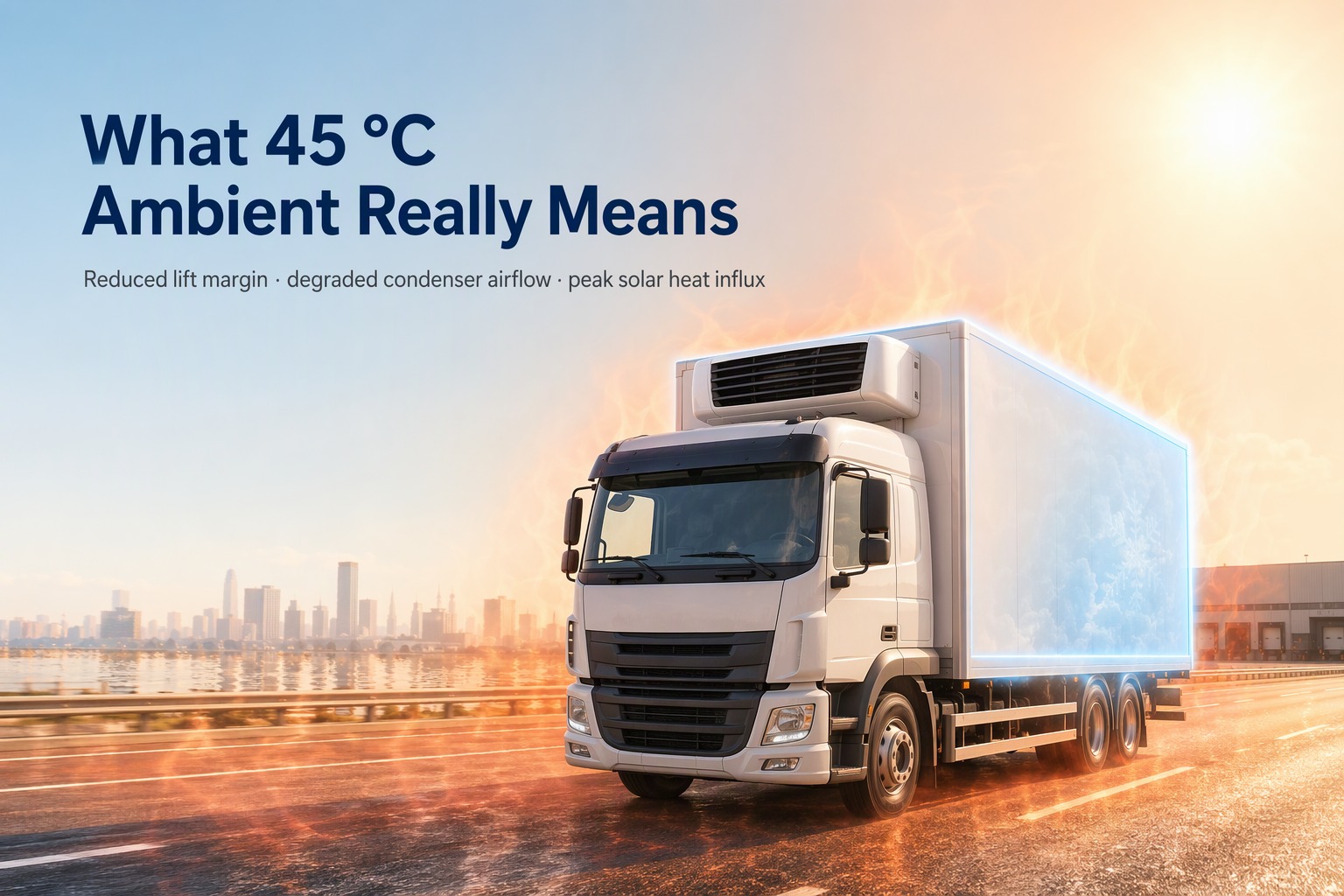
Operating under 45 °C ambient air introduces three compounding physical challenges that standard nominal ratings fail to disclose:
- Reduced Temperature Lift Margin: At 30 °C, there is a comfortable thermal lift margin between condensing temperature and ambient air. At 45 °C, that margin shrinks dramatically, meaning each additional ambient degree costs exponentially more cooling capacity.
- Degraded Condenser Airflow: A condenser coil relies entirely on high-velocity airflow across its fins. In dense city traffic or extended idling at loading docks, radiant road heat creates a local micro-climate hotter than ambient weather reports.
- Peak Solar & Box Heat Influx: Polyurethane insulation heat-leakage increases under direct solar radiation. The roof and side walls of a 4.2 m box absorb immense solar radiation, continuously adding heat to the cargo envelope.
Why an Oversized Heavy-Duty Condenser on a 5 kW Cooling Duty
Pairing an oversized rated heat-rejection condenser with a 3–5 kW cooling compressor may look excessive on paper, but it reflects real-world operational realities across a standard delivery day:
- First-Hour Peak Pull-Down: Removing residual overnight heat and initial cargo loading heat represents the peak thermal load of the day. Systems with matched nominal condensers bottleneck immediately during this critical hour.
- Rapid Door-Opening Recovery: Urban multi-drop distribution routes involve 15 to 25 door openings daily. Each opening floods the box with 45 °C humid air, requiring rapid, repetitive heat-rejection cycles to restore setpoint.
- Worst-Case Ambient Derating Buffer: Condensers must be sized for the worst operating hour of the year, not the annual average. Sizing up keeps discharge pressure within safe, efficient limits, protects compressor longevity, and ensures reliable performance even when dust accumulates on coil fins between routine maintenance intervals.
Airflow Architecture: Evaporator Delivery & Coil Integrity
A condenser with restricted airflow behaves like an undersized condenser. Regular coil inspection and fin cleaning are essential performance specifications in dusty or arid operating environments.
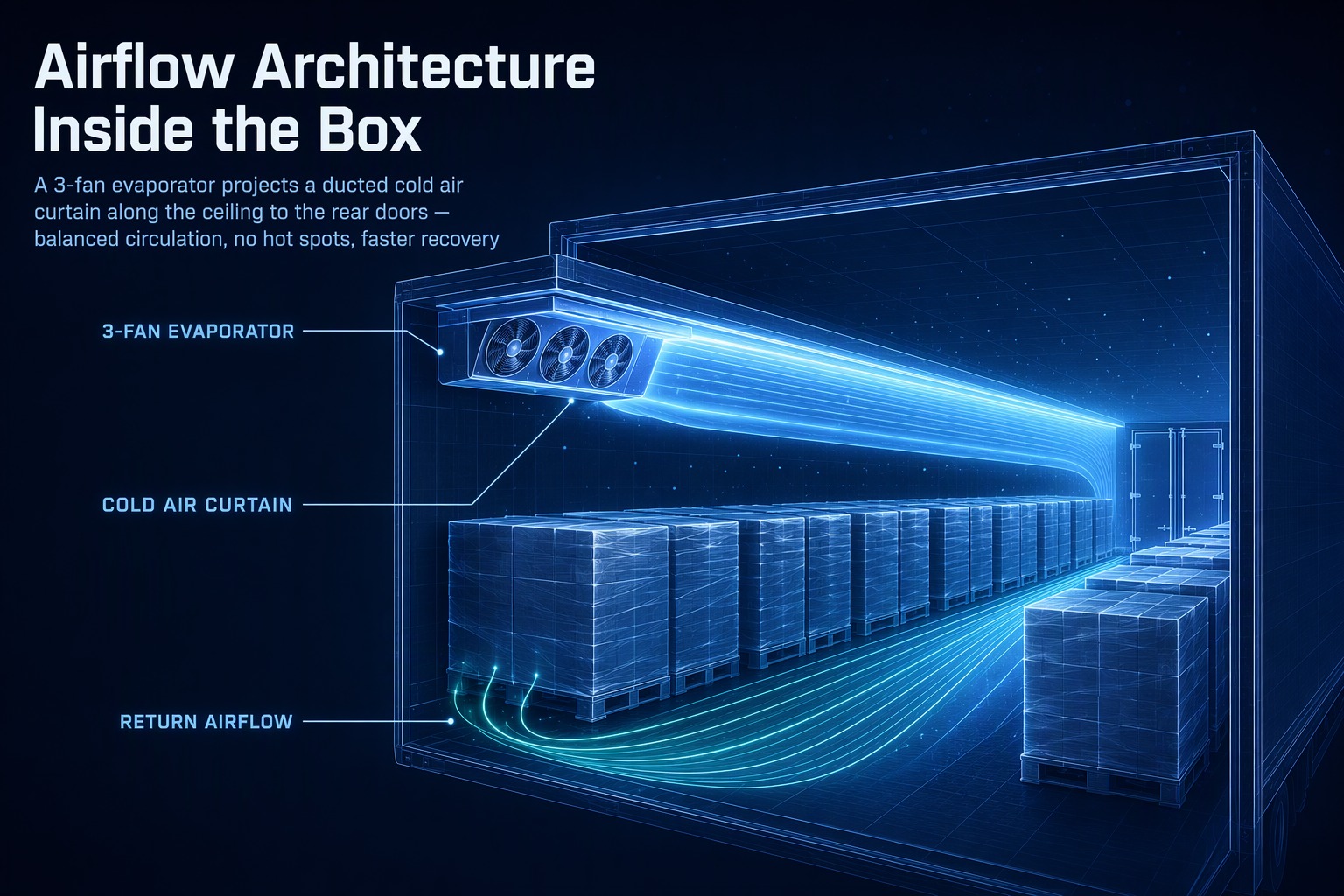
On the low-pressure side, internal airflow distribution is equally vital. The 3-Fan Indoor Evaporator (125 x 49 x 22 cm) features high-output multi-fan delivery, projecting a continuous ducted cold air curtain along the ceiling toward the rear cargo doors. This ensures balanced air circulation throughout palletized cargo in a 4200 x 2000 x 1900 mm cargo box without leaving hot spots or short-cycling, accelerating temperature recovery after door closures.
R404a Refrigerant & High-Pressure Stability
The DEFU refrigeration circuit utilizes R404a refrigerant, an established HFC blend optimized for medium- and low-temperature commercial refrigeration (0 °C to -18.6 °C). It exhibits robust thermodynamic characteristics under high ambient pressures, ensuring consistent liquid subcooling and rapid evaporator boiling. Maintaining system tightness through reinforced vibration-resistant copper piping is vital to preserve optimal charge levels and long-term operating efficiency.
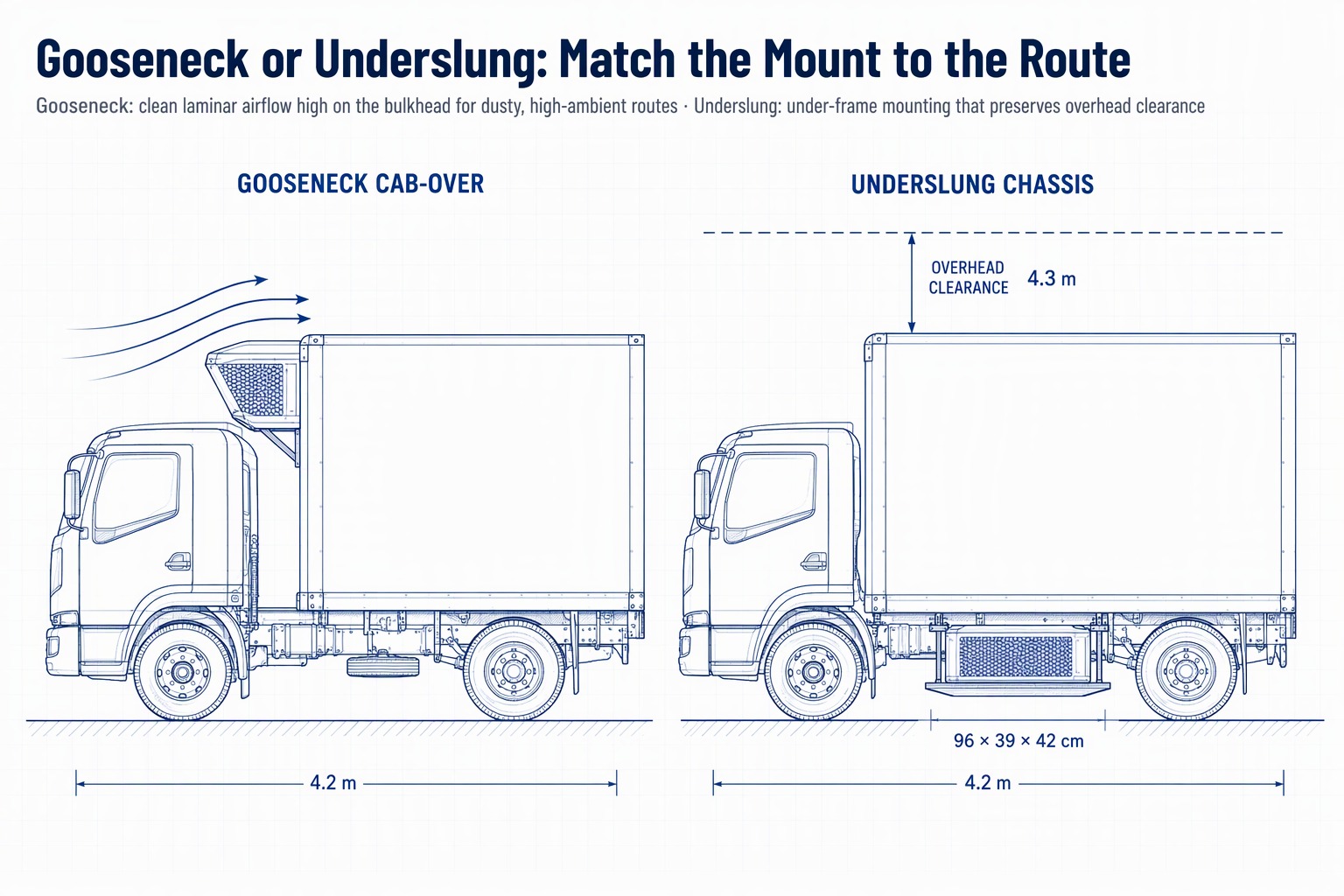
Gooseneck vs. Underslung: Choosing the Right Mounting Architecture
DEFU offers two distinct mounting configurations to match varying route conditions and chassis specifications:
- Gooseneck Cab-Over Mounting: Mounts the stainless steel trapezoidal condenser high on the front bulkhead above the cab. It captures clean, cool laminar airflow above road-level dust and heat, making it ideal for dusty, unpaved, or high-ambient desert routes.
- Underslung Chassis Mounting: Mounts the heavy-duty condenser (96 x 39 x 42 cm) securely under the chassis frame with integrated debris protection. It preserves maximum overhead clearance for low-bridge urban deliveries and keeps the front bulkhead clean.