EN

Cold-Weather Installation and Sealing for Rooftop Parking Air Conditioners
Cold-Weather Installation and Sealing for Rooftop Parking Air Conditioners
Installation quality determines whether a parking air conditioner survives its first winter. Most units are installed during warm months, when sealing materials cure quickly and the finished work looks correct. The defects appear months later: a water stain on the headliner, an intermittent earth fault, a blocked drain, or a fan that draws ice into the intake. Almost all of these problems are installation issues rather than product defects, and almost all of them can be prevented with a documented procedure. This article covers the installation and sealing decisions that matter most in cold weather.
Installation Quality Decides Winter Reliability
A rooftop installation involves cutting the cab structure, routing cables and refrigerant lines, and sealing against rain, snow, and pressure differences. Each of these steps has a cold-weather dimension. Sealant cured at low temperature may not bond fully; cables that were flexible in summer stiffen and crack where they bend sharply; drainage that flows freely at 20°C can freeze at −5°C and back water into the cab. The objective is a system that performs identically in February and August, and that can be inspected quickly by a technician who did not do the original work.
Sealant, Gaskets, and Temperature at the Moment of Installation
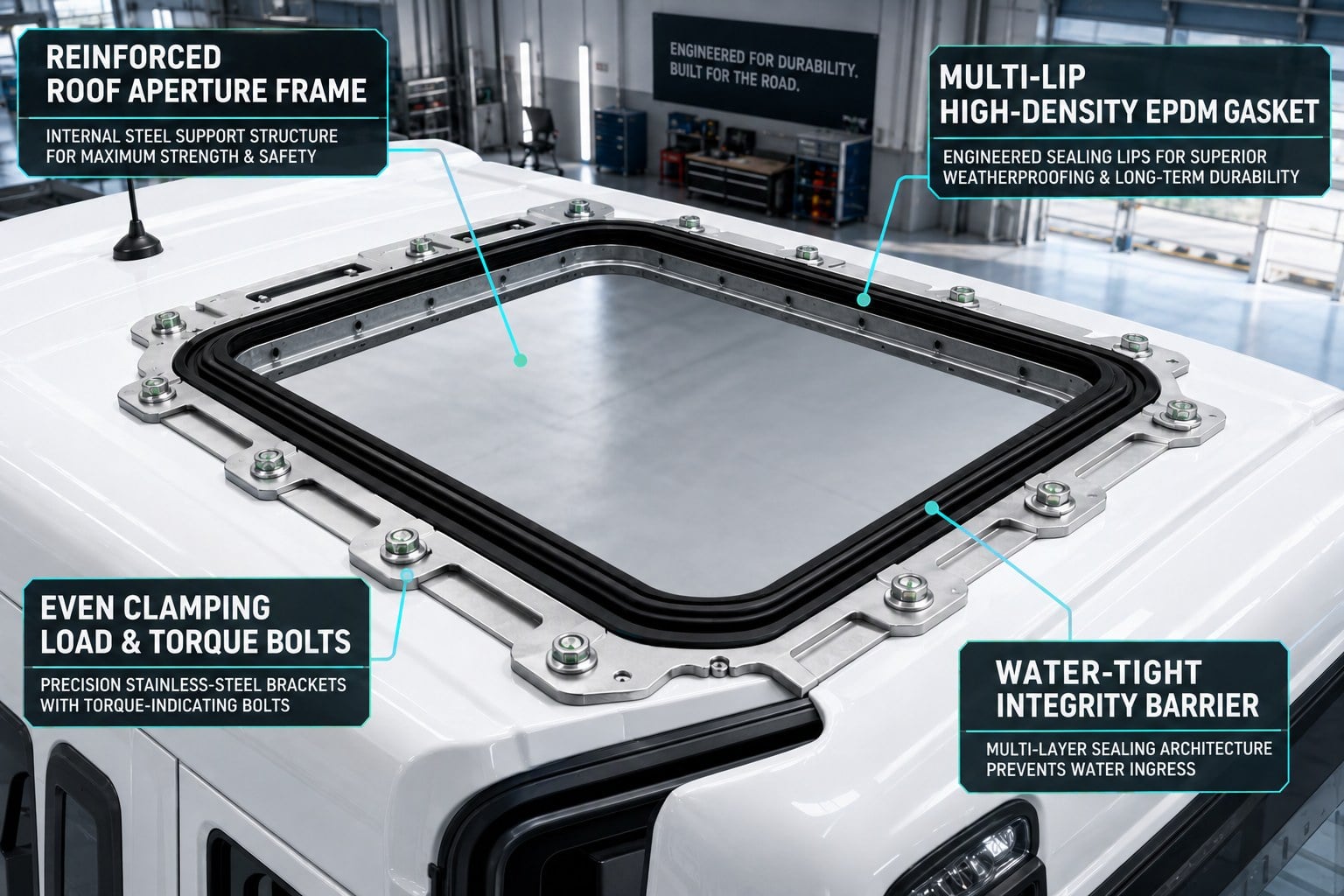
Sealant selection should be based on the manufacturer's specification and the temperature range in which it will cure, not on what is available in the workshop. Where an installation must take place in cold conditions, use products rated for that temperature, allow the full curing time before exposing the joint to water or vibration, and avoid applying sealant to damp or contaminated surfaces. Compressed gaskets should be inspected for correct seating and even clamping load. A joint that is simply "filled with sealant" is difficult to verify and usually fails within a season.
Roof Preparation, Reinforcement, and Load Considerations
The roof panel must be sound, clean, and flat enough for the gasket to seal. Corrosion, previous repairs, and thin panels that flex under wind load should be corrected or reinforced before the unit is mounted. Fasteners should engage a reinforced structure rather than sheet metal alone, and the mounting pattern should follow the manufacturer's drawing. Consider the additional weight of snow and ice where vehicles operate in severe winter conditions, and confirm that the roof and mounting bracket can carry the combined static and dynamic load.
Cable Routing, Connectors, and Low-Temperature Flexibility
Cables should be routed with continuous support, generous bend radii, and protection at every penetration. In cold conditions, insulation becomes less tolerant of sharp bends and vibration, so a route that survived a summer might crack in winter. Connectors must be sealed against moisture ingress and mounted where they cannot collect water. Earth connections should be clean, protected against corrosion, and sized for the current. Fuses and protection devices must match the manufacturer's recommendation, and the complete circuit should be documented so that a later technician does not have to reverse-engineer it.
Condensation, Drainage, and Freezing Risk
Condensate forms whenever a surface is below the dew point, and it forms more readily in a warm cab during cold weather when warm, humid air meets cold structure. Drainage lines should follow a continuous fall, avoid low points where water can collect, and terminate where discharge cannot be blown back into the intake or onto a hot surface. Where freezing is possible, the route should be as short and as vertical as practical. Traps are acceptable only if they are designed to drain in freezing temperatures.
Protecting Airflow Paths From Ice, Snow, and Debris
The roof unit depends on unrestricted airflow through the condenser and evaporator. Snow accumulation, ice formation at the intake, protective covers left in place, and debris such as leaves can all reduce performance or cause the unit to protect itself. Installation should leave sufficient clearance around every intake and outlet, and the design should make it clear to the driver where covers must be removed before operation. It is worth including this in the driver instruction card rather than relying on verbal handover.
Commissioning Checks Before the First Cold Night
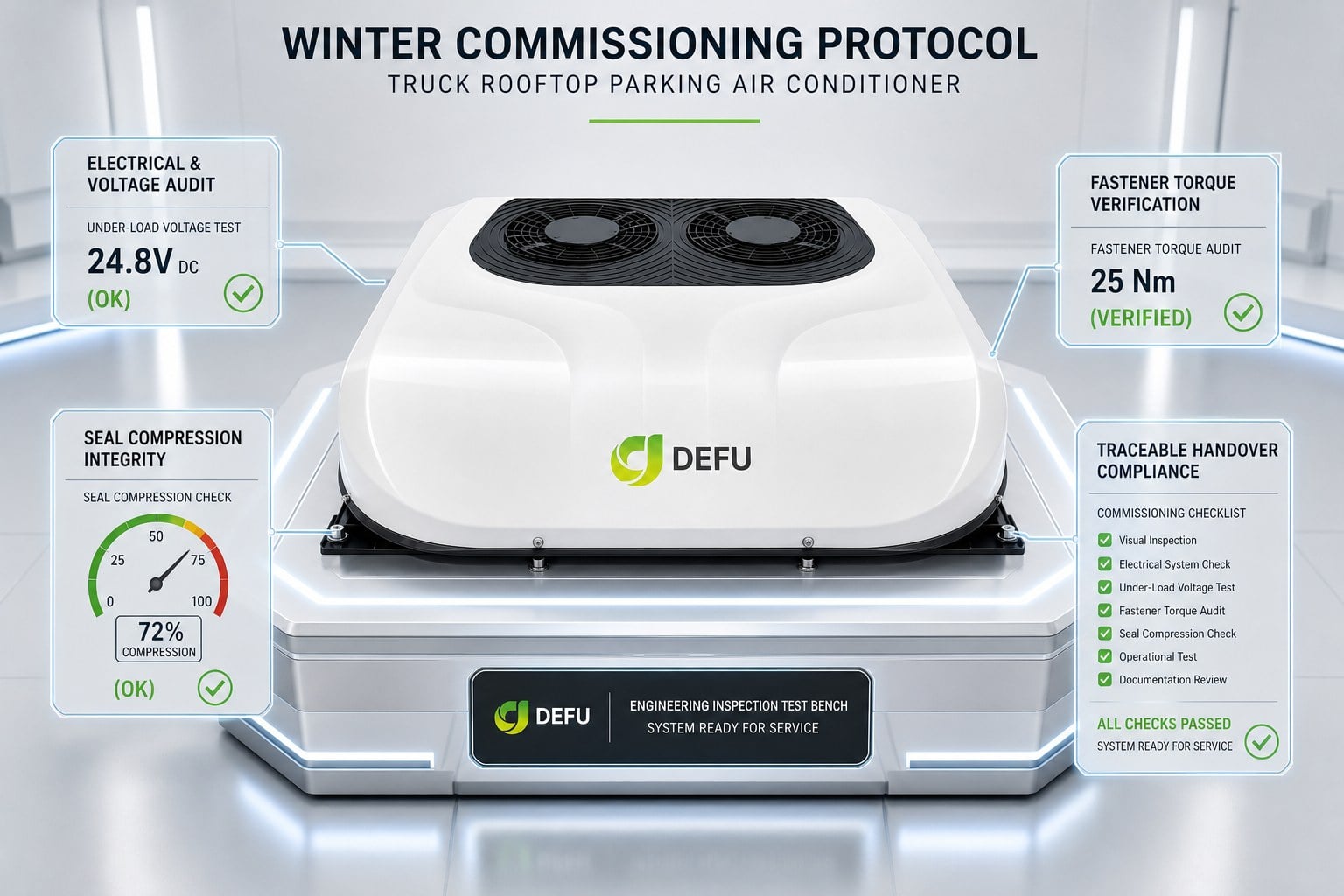
Commissioning should be a documented sequence rather than a quick test. Verify mounting torque, seal integrity, drainage flow, airflow clearance, cable condition, fuse rating, and voltage at the unit under load. Confirm controller settings, protection thresholds, and timer operation. Observe a full operating cycle, including startup and shutdown, and record the measured values. In cold weather, add a check of low-temperature startup behavior and of any defrost or anti-icing function.
Documentation and Handover
Every installation should end with a record: vehicle identification, unit model, serial number, installation date, technician, measured values, and any deviation from the standard procedure. Photographs of the roof opening, sealing, and cable routing are valuable when a warranty question arises later. Handover to the driver should cover operation, timer use, protection behavior, and what to report. This record is what allows a fleet or distributor to move from anecdotal problem descriptions to traceable technical analysis.
Conclusion
Winter reliability is largely determined on the day of installation. Correct sealing, reinforced mounting, protected cable routing, reliable drainage, clear airflow, and a documented commissioning process are what separate a dependable rooftop installation from a source of recurring complaints. Defu supports installers with mounting drawings, sealing guidance, torque specifications, and commissioning checklists that can be reused across a fleet.
If you are preparing a fleet rollout or a distributor installation program, request our installation documentation package. Send us your vehicle types and roof configurations, and we will confirm the recommended mounting, sealing, and commissioning steps before your workshop begins.