EN

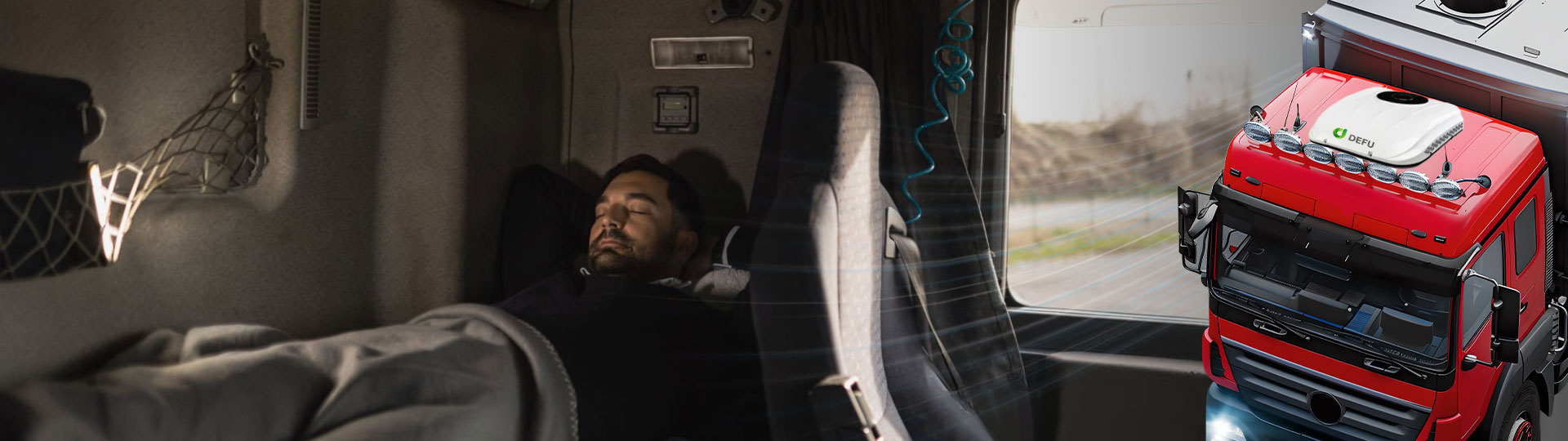
Calefactio Hiemalis Sine Inactione pro Turmis: Hydronica Diesel contra Idling Motoris
Calefactio Hiemalis Sine Inactione pro Turmis: Hydronica Diesel contra Idling Motoris
Aestas attentionem capit: refrigeratio venditur in Iulio, et refrigeratores stationis pretium marketing accipiunt. Sed pro factione cum vera hieme, calefacere est ubi pecunia effunditur — non in instrumentis, sed in combustibili consumpto ad statum immotum, in horis motoris accumulatis sine progressu, et in gubernatoribus qui motorem relinquent ardentem quia alterum est cabina frigida.
Hoc articulus comparat tres vias quibus factiones vere calefaciunt cabinae vel corporis, et ubi DEFU's Statio Thermica Hydronica Diesel Clausa et Calefactor Hydronicus Diesel Omnium-in-Unum conveniunt.
Quid idling revera constat
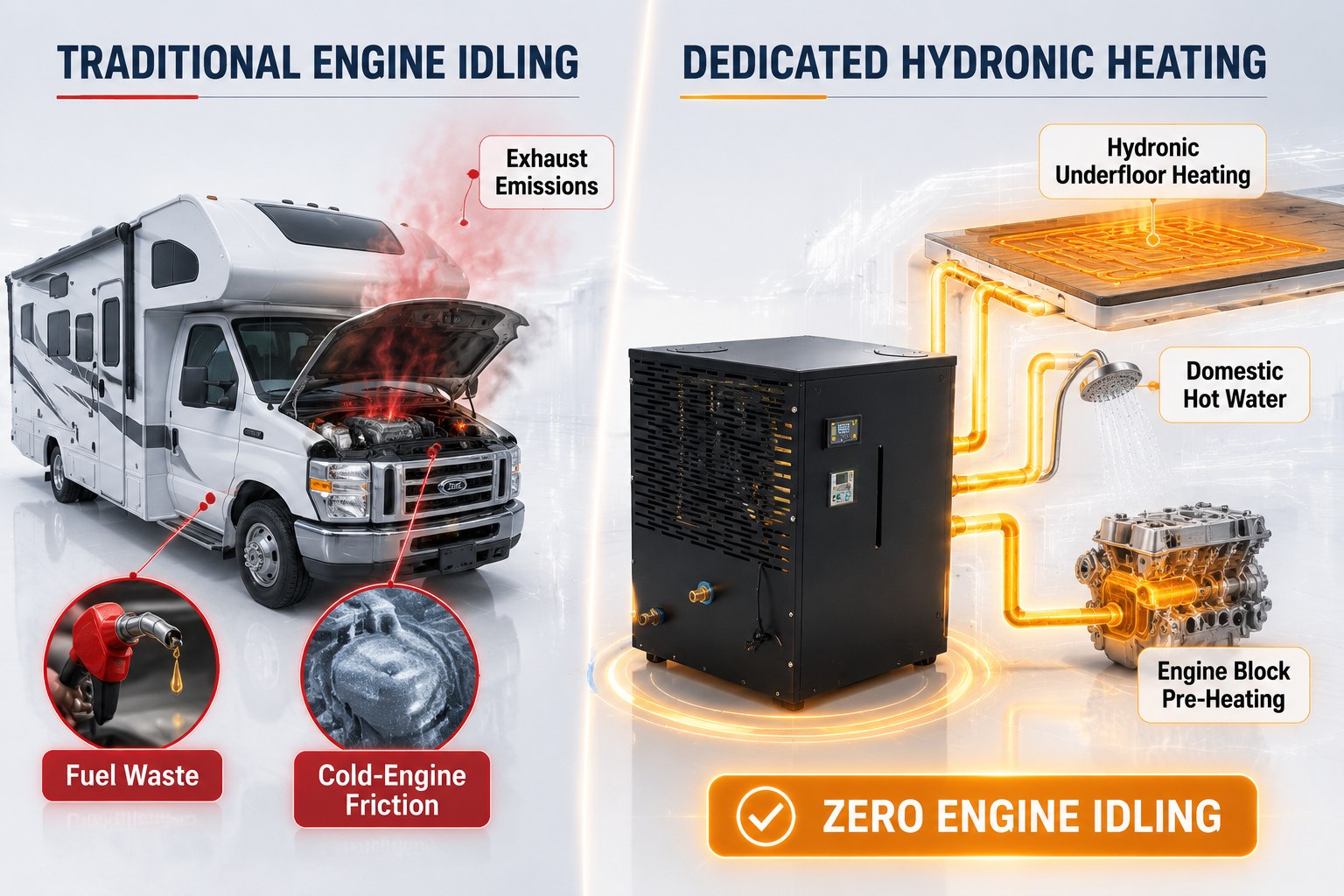
An idling heavy engine burns fuel to produce almost no useful work. The useful output is a few kilowatts of heat that a dedicated heater produces from a fraction of the fuel, because its combustion is optimized for exactly that task.
Three costs stack up beyond the fuel bill. Engine hours accumulate without distance, and resale value plus service intervals are driven by hours. Repeated cold idling does not warm an engine as efficiently as load does. And anti-idling rules are enforced in a growing number of jurisdictions, where "the driver was cold" is not a defence.
The three realistic options
Engine idling gives maximum heat at zero additional hardware, and maximum waste — and no heat at all with the engine off.
A diesel air heater heats air directly: fast to install, inexpensive, effective in a cab, but limited when heat must reach a box, tank, wash station or engine block.
Un heater hidronico diesel calda un circuito di refrigerante, e tale circuito puo poi alimentare diversi carichi termici: uno scambiatore di calore per la cabina, una serpentina per serbatoi, acqua calda sanitaria o preriscaldamento del motore. Richiede piu lavoro di installazione, ma offre molta maggiore capacita per unita. La scelta non e quale sistema sia migliore, bensi se si necessita di calore sotto forma d’aria o come fluido da indirizzare.
Il sistema idronico cessa di essere un lusso in quattro situazioni: si necessita di preriscaldamento del motore, che e la miglior azione possibile per ridurre il consumo di carburante invernale e prolungare la vita dell’avviamento; si necessita di calore in piu di un punto partendo da un unico generatore; si necessita di acqua calda per servizi equipaggio o per lavaggi; oppure si necessita di riscaldamento sia con alimentazione da rete elettrica che con alimentazione dal veicolo, dove conta la tensione duale.
Le due piattaforme DEFU
The Calefactor Hydronicus Diesel Omnium-in-Unum covers 10–40 kW in one compact body: integral fuel-water tank, brazed plate heat exchanger, dual voltage DC 12/24 V and AC 110/220 V, dimensions 750 × 500 × 500 mm. It suits trucks, motorhomes and light commercial builds where the heater fits an existing space and serves a single loop. The brazed plate exchanger is why it responds quickly, with very little thermal lag.
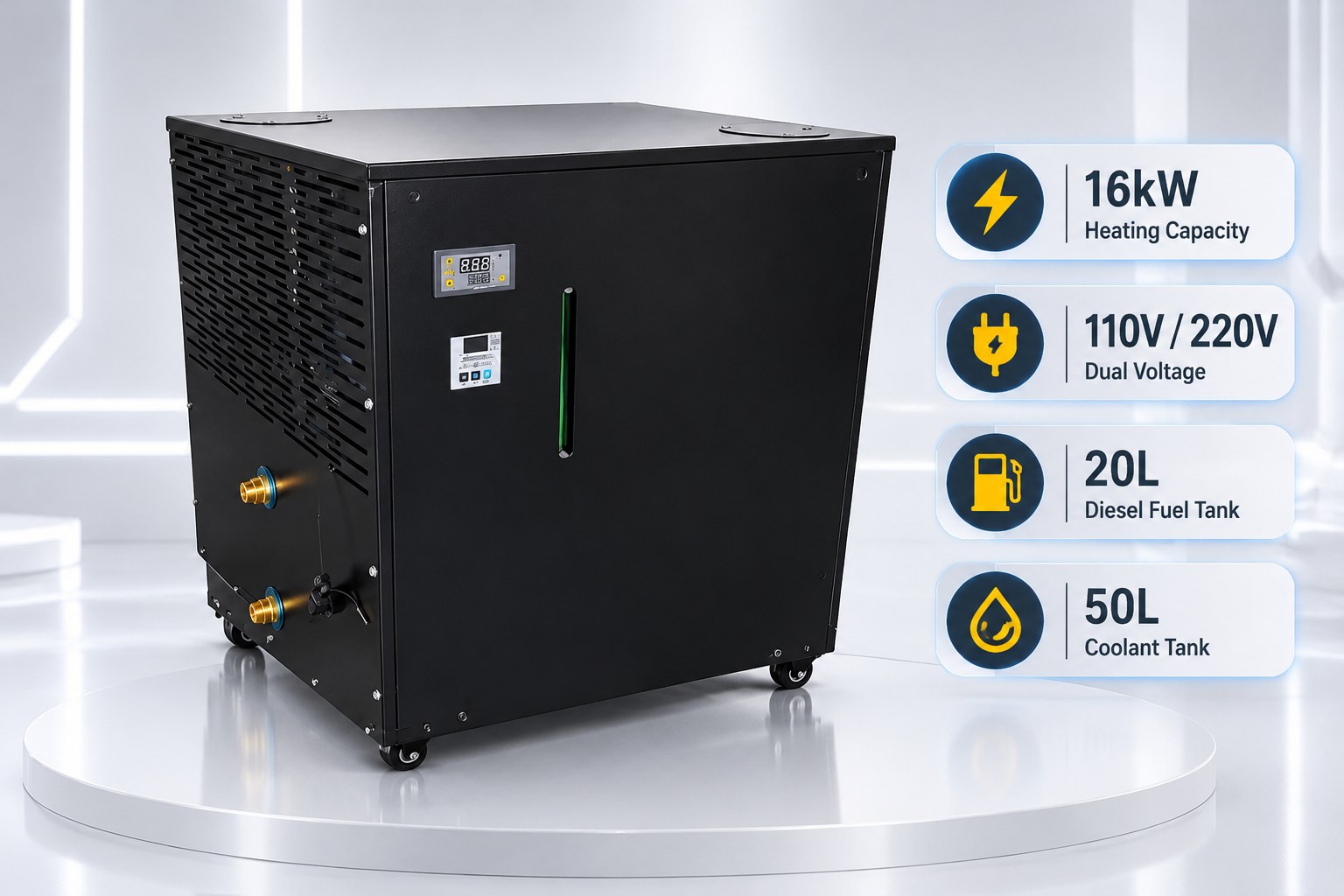
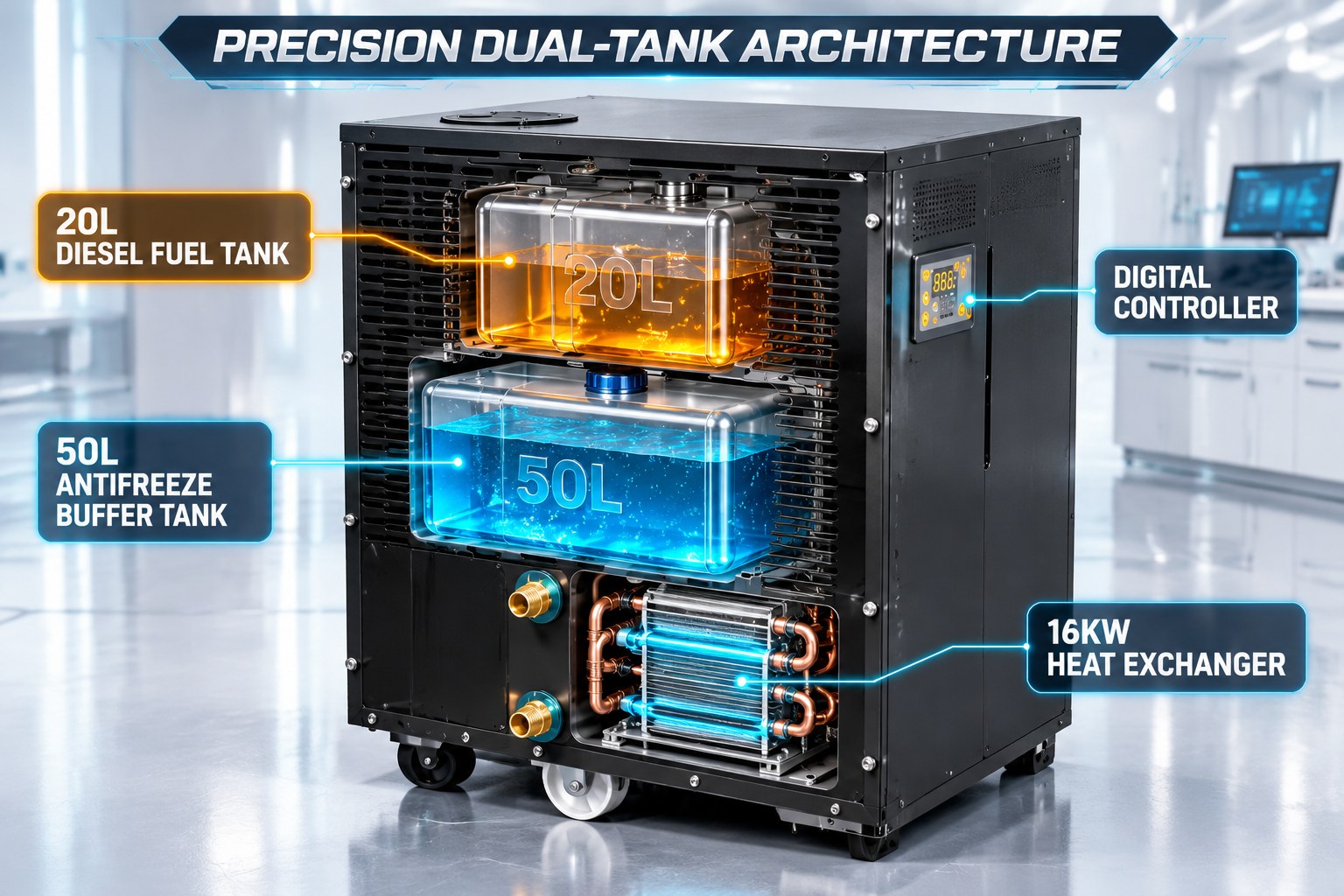
The Enclosed Boiler Station delivers 16 kW from a cabinet enclosure with 110/220 V dual voltage, a 20 L diesel tank, a 50 L coolant tank and 650 × 350 × 600 mm dimensions. Enclosure and coolant volume make it a station rather than a heater: enough thermal mass to ride out demand spikes, enough fuel for extended unattended operation. It is the unit for depot heating, cabin heating, frost protection of an unoccupied building, or a workshop with several simultaneous draws.
The distinction is simple. The all-in-one is a heater you install; the boiler station is a thermal plant you connect things to.
Sizing without over-thinking it
Three inputs decide most of the answer: heat load in kW from cab volume, insulation, glazing and design ambient; loop volume in litres, because more coolant means slower warm-up and steadier temperature; and duty pattern, since unattended frost protection differs from a driver warming up before a shift. Size to the design temperature you operate in, not the coldest night of the year.
Installation points that decide whether it works
Route exhaust away from air intakes, doors and cargo. Provide dedicated clean combustion air, never drawn from the heated space. Fill and bleed the coolant circuit properly, because air in the loop is the first cause of "the heater runs but there is no heat". For dual voltage units, use an interlocked changeover rather than a shared terminal.
Fleets that switch from idling report the same three things: the cab is warm before the shift because pre-heat is possible, the windows stay clear, and the noise is gone.