EN

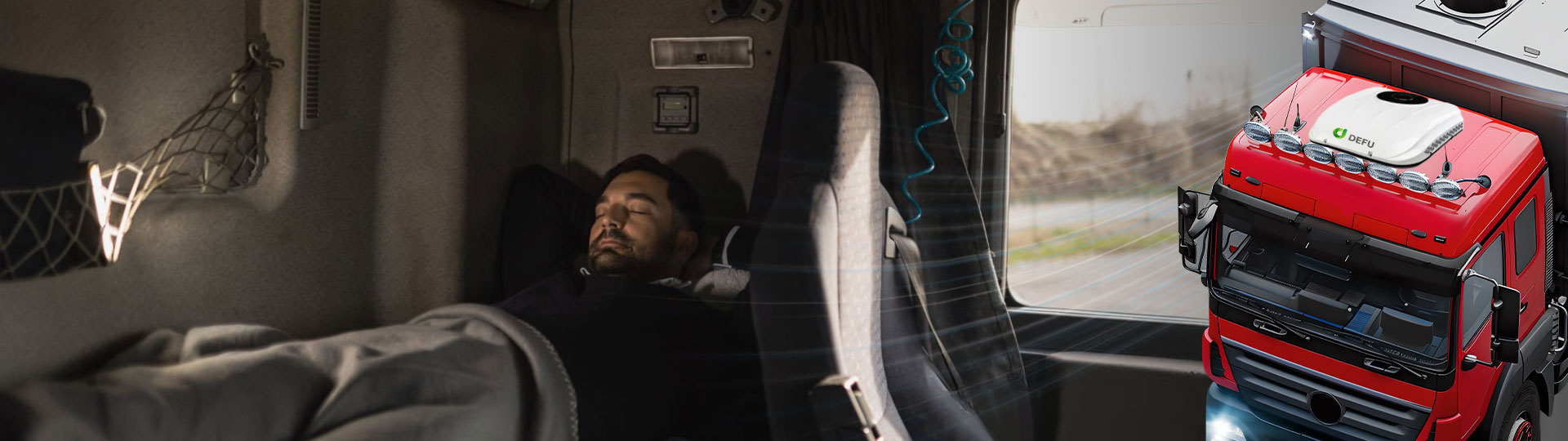
98% Availability Is the New Target. Cabin Climate Belongs in the Uptime Equation.
98% Availability Is the New Target. Cabin Climate Belongs in the Uptime Equation.
A single sentence from a Mercedes-Benz executive on 21 October 2026 explains more about the next twelve months of Brazilian trucking than most market forecasts. Speaking at the company's 70th-anniversary event in São Bernardo do Campo, vice-president of sales Jefferson Ferrarez described how e-commerce clients have moved the goalposts on vehicle availability: the market used to work with 96% or 97% uptime, and these customers are now asking for 98%.
Two percentage points sounds like rounding. Applied to a fleet of 200 tractors, it is roughly 35,000 additional vehicle-hours of availability per year — a difference that has to come from somewhere. Maintenance intervals, parts logistics, service response, and, less obviously, the way a cab is allowed to be used during mandatory rest.
That last item is where parking air conditioning moves from comfort accessory to uptime component. Here is the argument, and here is how to test it against your own operation.
Where the two points actually come from
When a fleet engineer explains an availability gap, the causes cluster into four buckets: unplanned mechanical failure, scheduled service that overruns, waiting for parts, and vehicle unavailability for reasons that never make it into the workshop report — a truck that cannot be dispatched because the driver is unfit, or because the cab is unusable in the heat.
The first three are well understood and heavily managed. The fourth is where Brazilian operations quietly lose hours, especially on long-haul runs through the Centre-West and Northeast, where a driver may be resting in a cab that has become uninhabitable by early afternoon.
A cab that cannot be cooled without running the engine produces three simultaneous costs:
- Fuel burned at zero kilometres, which the fleet pays for and no customer reimburses.
- Engine hours added without distance, which pulls forward the service interval on a vehicle that is not earning.
- Rest quality degraded, which shows up later as fatigue-related risk and, in the worst case, as a driver who leaves for a competitor with a better truck.
None of these appear on a line item called "air conditioning". All of them show up in availability.

Idle is an uptime problem before it is a fuel problem
Most of the parking AC conversation in Brazil is framed around diesel savings, and that framing is correct but incomplete. For a fleet chasing 98%, the more persuasive argument is mechanical.
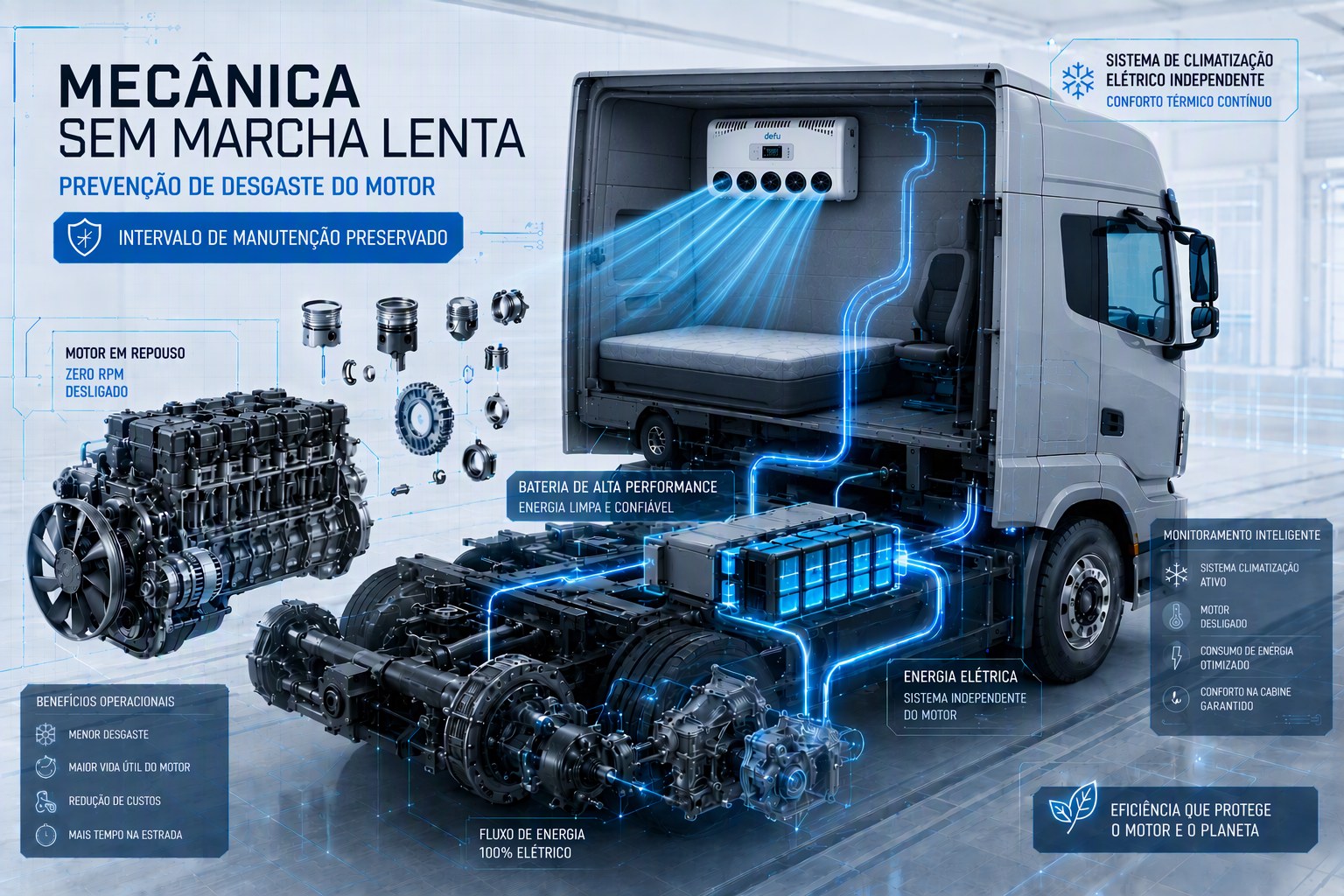
Every hour of idling adds an hour to the engine's operating life while adding no distance. If your maintenance schedule is driven by hours rather than kilometres — as it is for many heavy fleets — idling accelerates the service cycle on the asset that is supposed to be generating revenue. For a truck resting eight hours a night, the arithmetic is uncomfortable: over a year, that is a substantial block of engine hours spent standing still.
Now consider what an independent, battery-driven cooling system changes. The engine stops. The hours stop accumulating. The service interval tracks distance again. The driver sleeps in a cab that is at a stable temperature. And the fuel that would have been burned at zero km/h stays in the tank.
This is why the strongest business case in Brazil is not "comfort" and not even "fuel". It is asset utilisation: the same truck, the same driver, the same route, with fewer hours consumed and one less reason for the vehicle to be unavailable.
The availability checklist buyers are starting to use
Fleets that have internalised the 98% target are beginning to ask cabin cooling suppliers a different set of questions. If you are preparing a specification, these are the ones worth putting in writing:
- What happens to the start battery? A system without a protection cutoff is an availability risk disguised as a cooling unit. Ask for the low-voltage cutoff behaviour and how it is configured for a 24V pack that also feeds telematics, refrigeration controls and cab electronics.
- How many hours can the system run on the installed bank, in Brazilian conditions? Not at a laboratory ambient temperature — at 35°C and above, with a cab that has been in the sun.
- What is the service model when something fails in Rondonópolis rather than São Paulo? Availability is a function of repair speed. A product with no local parts path is a 96% product.
- Does installation touch the vehicle's original system in a way that creates a new failure mode? Roof-mounted and split systems have different answers here, and the honest ones are configuration-specific.
- What data does the system produce? Hours run, energy drawn, faults logged. If a fleet is managing availability with telematics, a cooling unit that reports nothing is a blind spot.

The 2027 context makes this urgent, not theoretical
The same executive briefing contained the less comfortable numbers. Industry projections point to a Brazilian truck market of around 110,000 units in 2027, similar to 2026. High interest rates and tighter credit conditions are expected to keep pressuring the market. Agribusiness — the main buyer of heavy models — is facing rising judicial recovery filings, which leads banks to apply stricter criteria before approving financing.
Translated: fleets are not going to solve an availability problem by buying their way out of it. When capital is expensive and credit is selective, the availability gain has to come from the assets already in the yard. That is precisely the argument for retrofitting climate control onto working trucks rather than waiting for replacement cycles.
The sector has also been reminded that renewal demand is real but delayed: trucks that were not replaced over the past two to three years now carry maintenance costs high enough that keeping them running stops being economically rational. Until those replacements happen, those vehicles need every hour they can produce.
What to measure before you buy anything
If you want to test the thesis in your own fleet this quarter, you do not need a pilot programme. You need three numbers from your telematics or tachograph data, for one representative route:
- average hours parked per night with the engine running for climate reasons;
- litres per hour consumed at idle for that vehicle configuration;
- the current service interval in engine hours, and the cost of one service event.
Multiply the first by the second to get the fuel case, and the first by the service cost per hour to get the mechanical case. Add a judgement about driver retention, which no spreadsheet will settle but every operations manager understands.
If the combined figure is smaller than the installed cost of a system divided by its expected service life, the answer is no — and you have saved yourself a purchase. In our experience with Brazilian long-haul profiles, the answer is usually the opposite, but the point is that the fleet should own the calculation, not the supplier.
Where Defu fits
Defu supplies parking air conditioning for commercial vehicle cabs in 12V and 24V configurations, in rooftop and split formats, built for the trucks that Brazilian fleets actually run rather than for a show stand. We are interested in the availability conversation because it is the honest one: a cooled cab that lets the engine stop is a cab that returns hours to the operation.
If you are working toward a 98% target and want to know what a retrofit would return on your own route profile, send us one route's numbers. We will help you build the case — including the version where the answer is that you should not buy yet.